
Beyond AI Adoption: Turning Enterprise Intelligence into Business Value
A leadership perspective on measuring the real business impact of AI, from productivity and operational quality to verified financial outcomes and continuous improvement.

Key takeaways
- Measure the work AI improves, validate the financial impact, and scale only what delivers dependable business results.
- Keep existing business measures and add AI-specific ones that explain the change. Adoption alone does not show that the business performs better.
- Distinguish estimated capacity gains from validated savings before deciding where to invest.
On this page
Artificial intelligence is moving from experimentation into the everyday work of enterprises. Employees use copilots, teams automate repetitive tasks, and AI agents increasingly help coordinate complex business processes. Yet a fundamental question remains unanswered in many boardrooms: Are these investments making our business better?
Usage dashboards alone cannot answer that question. An organization can have widespread AI adoption without improving customer satisfaction, operating margins or service reliability. Leaders need a way to connect the activity of AI to the outcomes their businesses depend on.
A September 2025 Pragmatic Engineer analysis (opens in a new tab) of measurement practices at 18 technology companies offers a useful starting point. Engineering leaders are combining AI adoption indicators with established measures of delivery, reliability, quality and employee experience. They are looking at trends over time and testing whether AI is genuinely improving work.
At LigaX, we believe this approach belongs in every business function, not just software development.
The shift from activity to outcomes#
AI adoption tells us whether people and systems are using a capability. Business impact tells us whether the capability is worth investing in. The distinction matters because faster work is not always better work, and saved time does not automatically become financial savings.
The most valuable AI metric is not how much AI we use. It is how much better the business performs.
Leadership teams should retain their existing business performance measures and add AI-specific measures that help explain the change. A telecom operator should still care about network availability. A finance team should still care about accurate reporting. A customer operations leader should still care about resolution quality and customer trust.
AI should help improve those outcomes, not replace them with new activity metrics.
What should leaders measure?#
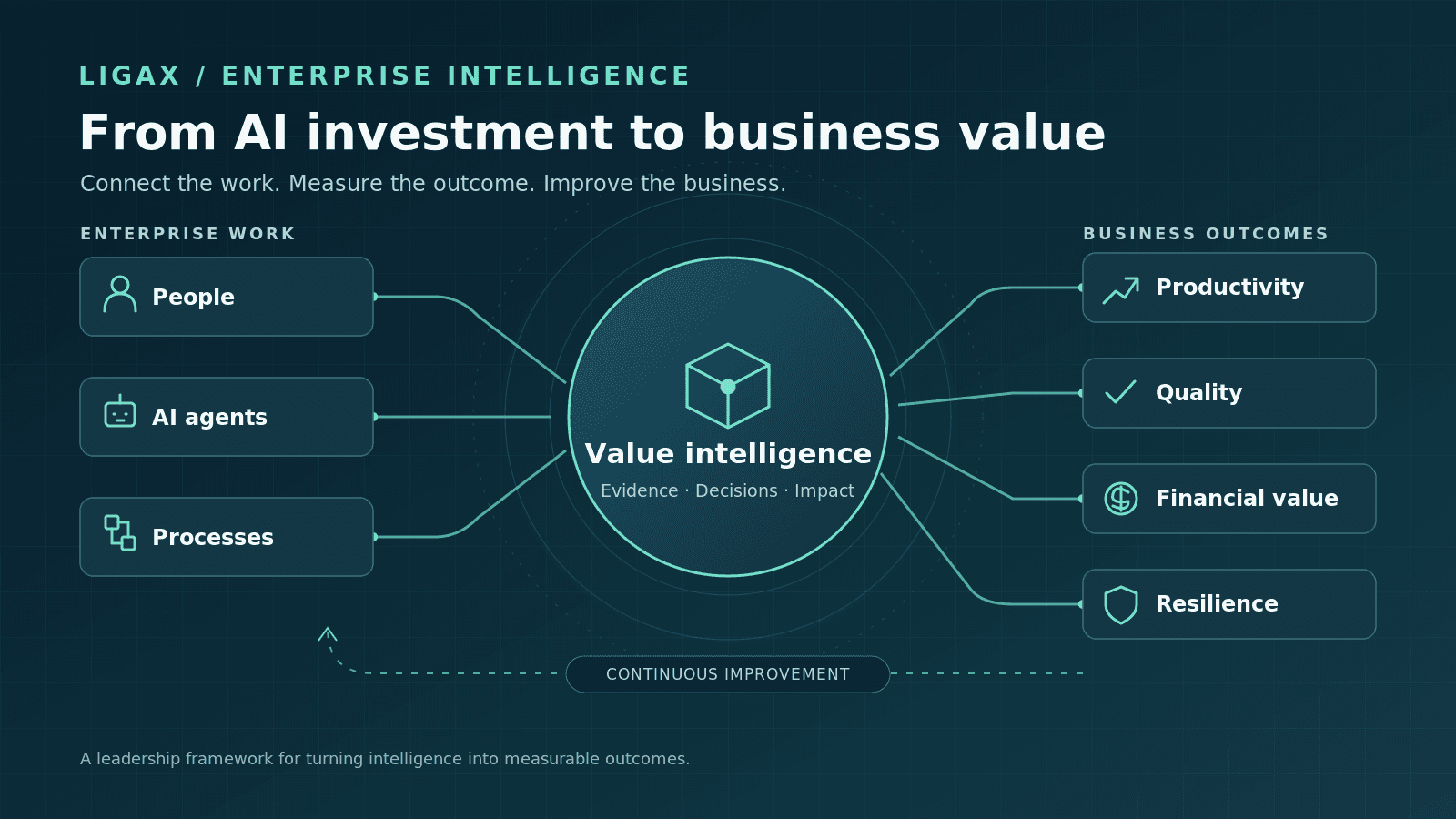
We propose a balanced framework that brings business performance, AI performance and financial accountability into a single view.
| Leadership question | What to measure |
|---|---|
| Are we more productive? | Completed work, cycle time, cost per task and capacity released. |
| Are we delivering better outcomes? | First-time-right rates, customer satisfaction, errors and rework. |
| Are we creating financial value? | Verified savings, cost avoidance, incremental profit and return on investment. |
| Can we trust autonomous agents? | Validated completions, escalations, policy exceptions and human oversight. |
| Are we becoming more resilient? | Service reliability, recovery performance, operational risk and control effectiveness. |
These measures work together. If processing speed rises while errors and escalations rise too, leaders should investigate before scaling. A balanced scorecard helps prevent short-term efficiency from creating long-term problems.
What this looks like in real operations#
Consider a fiber network operator. AI agents may prepare permit submissions, identify missing documents and flag applications at risk of delay. The meaningful outcome is not the number of agent interactions. It is fewer avoidable rejections, shorter approval cycles, better forecast accuracy and earlier network activation.
In customer operations, AI can classify requests and support service agents. Success means lower cost per resolved request without compromising customer satisfaction. In cybersecurity, the objective is not simply processing more alerts; it is reducing exposure and resolving incidents safely. In finance, the objective is faster, more accurate processing with stronger controls.
Illustrative business case
What does a more efficient support process actually deliver?
- Monthly capacity released
- 1,000 hrs
- Realized monthly benefit
- $25K
- Net monthly value
- $15K
Suppose a team handles 12,000 requests monthly and AI reduces human effort from 15 to 10 minutes per request. At an assumed loaded cost of $40 per hour, this releases $40,000 of potential capacity value. If finance validates $25,000 of realized benefits and AI costs $10,000 per month, the net benefit is $15,000, or 150% net ROI. This hypothetical example assumes equivalent service quality and excludes other unmodeled costs. It is not a LigaX customer result.
Making this distinction explicit helps leadership prioritize investments based on what the enterprise actually realizes, rather than what a productivity estimate promises.
The LigaX vision: intelligence that improves the business#
Enterprises need an intelligence layer that connects their people, agents, applications and business processes. Our vision for LigaX Value Intelligence is to help organizations understand where AI is deployed, how it performs, what value it creates and what action to take next.
Rather than asking leaders to replace their existing ERP, CRM, service management or operational systems, this proposed platform would connect to them and bring their signals together. It would link AI activity to the corresponding business process, capture evidence of outcomes and make investment decisions easier to evaluate.
One view of value, from the boardroom to the front line#
For senior leadership, that means visibility into the financial returns, risks and strategic opportunities across an AI portfolio. For operations leaders, it means actionable insights into bottlenecks, service quality, workload and exceptions. For technology leaders, it means understanding which models and agents deliver reliable results at the right cost.
A ledger for AI-generated value#
We envision a value ledger that records each material AI benefit with a business owner, baseline, evidence, measurement method and approval status. Estimated capacity gains would be distinguished from validated savings and incremental profit. This creates a common language for operations, technology and finance.
From insight to action#
A dashboard is only the beginning. The next step is identifying a problem, recommending a change, securing the appropriate approval and verifying the result. Over time, this creates a continuous improvement loop where enterprises can learn which AI investments work, refine those that underperform and retire those that do not justify their cost.
A practical leadership playbook#
Start with a small number of high-value processes, not a technology-wide rollout. Every initiative should have a clear business objective and someone accountable for its outcome.
Establish the baseline. Record current costs, cycle times, quality and service performance before changing the workflow.
Deploy against a specific objective. Choose a bounded use case with a meaningful business outcome and appropriate controls.
Test the impact. Compare similar work before and after implementation, or use matched teams or controlled pilots where practical. Account for differences in complexity, seasonality and workload.
Validate the value. Bring operations and finance together to confirm realized benefits, total costs and quality safeguards. Use aggregated team-level measures rather than intrusive employee surveillance.
Scale what works. Expand proven use cases, improve weak ones and monitor the results as the business changes.
The future is a continuously improving enterprise#
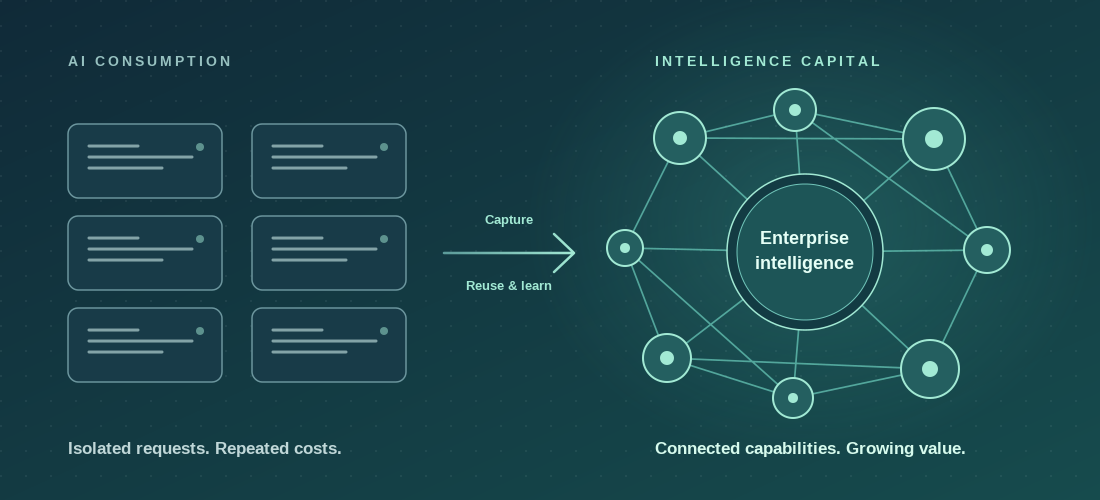
AI is becoming a new form of productive enterprise capital: a capability that can be deployed, improved and evaluated against the value it creates. Realizing that potential requires more than access to a powerful model. It requires business context, trusted evidence, responsible governance and continuous learning.
Organizations that build those foundations can make better decisions about where to allocate resources, how to improve operations and how to pursue new growth. The opportunity for leadership is to turn intelligence into a repeatable business capability, not a collection of disconnected AI experiments.