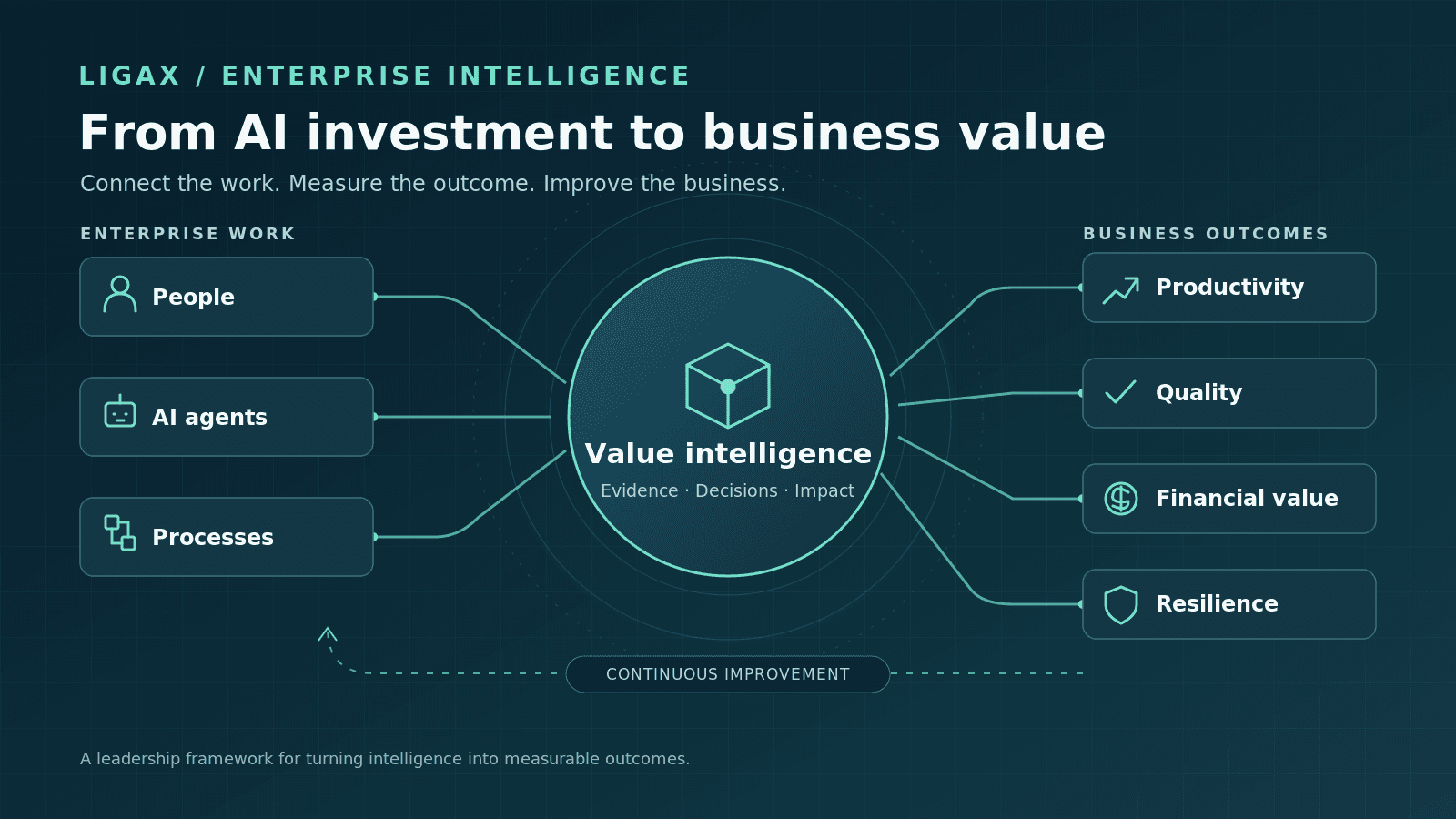

The next enterprise asset is intelligence.
Why enterprise intelligence is becoming a productive form of capital, and how LigaX envisions the infrastructure that will help businesses create, own and grow it.

Key takeaways
- Intelligence capital is the reusable knowledge, decision and execution capabilities an enterprise builds from its own verified experience.
- Captured, validated and reused, that experience can compound, but it must be maintained, evaluated and governed like any other productive asset.
- Use the right intelligence for each task. A rule, an approved workflow or a small model is often a better choice than an expensive one.
On this page
For centuries, businesses have grown by investing in assets that increase their ability to produce value. Factories expanded manufacturing capacity. Software and networks transformed how information moved. Skilled people brought knowledge, judgment and experience to every part of the enterprise.
Artificial intelligence introduces a new possibility: businesses can turn their knowledge and experience into capabilities that make decisions, perform work and improve over time. We call this intelligence as productive enterprise capital.
At LigaX, our vision is to build the infrastructure that helps enterprises create, own, govern and grow this new form of capital.
From using AI to owning intelligence#
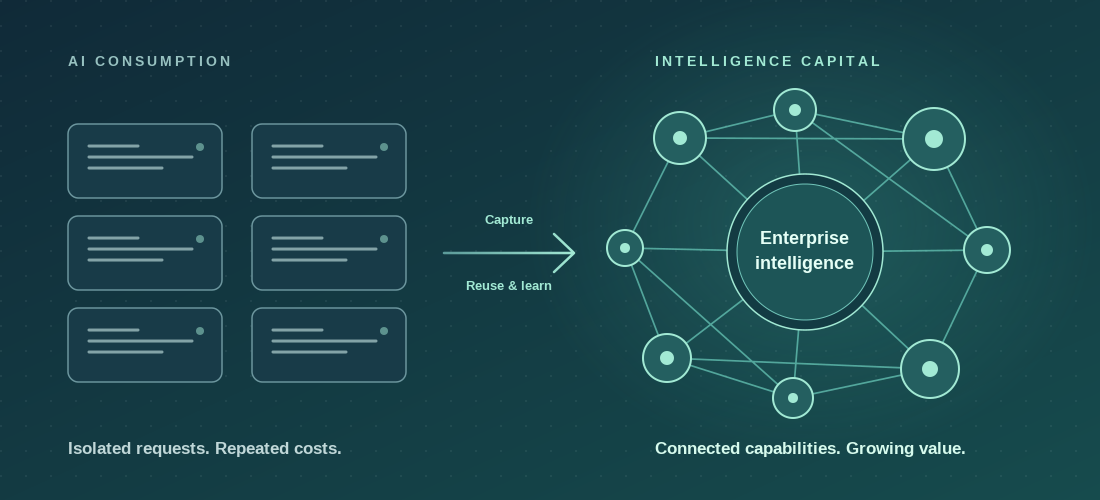
Most organizations begin their AI journey with chatbots, copilots or individual automations. These tools can deliver real value, but they often solve each problem independently. The business pays for a model to process information, generate an answer or execute a task. When a similar request arrives, the process begins again.
Now imagine an enterprise that takes a different approach. Every successful decision, expert correction and verified business outcome can become part of its organizational knowledge. Over time, recurring tasks are converted into reusable skills, reliable workflows and specialized decision capabilities.
Consuming AI
Use intelligence to solve today's problem.
Pay for each new request.
Depend on external capabilities.
Building intelligence capital
Turn today's experience into tomorrow's capability.
Reuse what has already been learned.
Build enterprise-specific competitive advantage.
Both companies may have access to the same AI models. But the company that retains and applies its own verified experience has the opportunity to become progressively more productive.
The value of AI is not only in the work it performs today. It is in the capability it leaves behind for tomorrow.
What is intelligence capital?#
Intelligence capital is the collection of reusable capabilities that enable an enterprise to understand its business, make better decisions and perform work more effectively.
- Knowledge
What the business knows about its customers, operations, assets and policies.
- Decision capabilities
How the business evaluates situations, predicts risks and chooses actions.
- Execution capabilities
How work is performed through agents, workflows, tools and reusable skills.
- Operational experience
What the business has learned from past outcomes, mistakes and expert guidance.
- Coordination
How people, systems and digital workers operate together.
- Trust and governance
Which capabilities are validated, who can use them and what actions are permitted.
Unlike a static knowledge base, these assets can be put to work. They can support thousands of transactions, multiple business teams and new applications — provided they are relevant, authorized and reliable.
Intelligence that can compound#
Every business activity creates an opportunity to learn. A resolved network incident, a successful permit application, a completed customer order or an approved engineering design contains information that could improve the next similar activity.
When the enterprise captures the right evidence, validates what worked and makes that learning available for future work, intelligence has the potential to compound. The next decision can become faster, the next task more reliable and the next application less expensive to build.
This is not automatic. Business conditions change, policies evolve and models become outdated. Intelligence must be maintained, evaluated and governed just like any other productive asset.
An example from telecom
Turning permit experience into business advantage
A fiber network operator applies for permits across hundreds of jurisdictions. Each application reveals local requirements, common rejection reasons and typical approval timelines.
Instead of treating every permit as an isolated task, the enterprise can build reusable jurisdiction knowledge, document checks and approval-time forecasts. For a new project, that intelligence can help anticipate delays, prioritize submissions and coordinate construction crews.
The benefit extends beyond permitting: better project planning, fewer avoidable delays and potentially earlier revenue activation. The permit workflow becomes a productive business capability.
The infrastructure behind the intelligence economy#
Owning intelligence is only useful if a business can put it to work. Enterprises need a common foundation that connects their knowledge, decisions, people, agents and existing systems — securely and at scale.
We call this enterprise intelligence infrastructure. Just as cloud infrastructure made computing available across organizations, intelligence infrastructure should make trusted, reusable business capabilities available wherever work happens.
In practice, this means connecting to existing business systems, capturing enterprise knowledge, selecting the appropriate intelligence for each task, coordinating execution and validating results. Intelligence should be able to run in the cloud, in private environments or closer to the devices and data it serves.
Not every task requires an expensive AI model. A simple rule, an approved workflow, a small specialized model or a previously validated result may be the better choice. The goal is not to use more AI; it is to achieve more business value with the right intelligence.
From AI spending to intelligence investment#
Today, business leaders often evaluate AI using adoption rates, token costs or the number of agents deployed. Those measures matter, but they tell only part of the story.
Tomorrow, leaders should also ask: What reusable intelligence have we created? How much work can it perform? How often is it reused? Is it still accurate? What economic value is it generating?
We believe these questions will lead to a more mature way of managing AI investments. An enterprise can measure the cost of a successful business outcome, the value of a reusable capability and the risk of relying on an individual vendor or employee. It can then direct its investment toward the intelligence that delivers the greatest benefit.
Intelligence capital is an economic concept, not a claim that all internally developed AI assets qualify for balance-sheet recognition. Its value should be demonstrated through measurable outcomes such as lower costs, faster execution, improved quality and increased productive capacity.
Building the intelligence-native enterprise#
In the coming years, we envision a shift from enterprises organized around applications to enterprises organized around outcomes. Existing business systems will continue to play a critical role, but a shared intelligence layer can help coordinate decisions and work across them.
People will remain responsible for setting direction, defining policies, exercising judgment and overseeing important decisions. Digital workers and connected systems can take on appropriate tasks within those boundaries. The enterprise will gain a growing body of intelligence that belongs to the business and can be improved with experience.
Our ambition at LigaX is to make this possible: to help businesses move from isolated AI adoption toward intelligence they can control, reuse, measure and grow.
The next competitive advantage will not simply come from having access to intelligence. It will come from how effectively an enterprise turns intelligence into productive capacity.