
Beyond AI agents: Building an enterprise that gets smarter
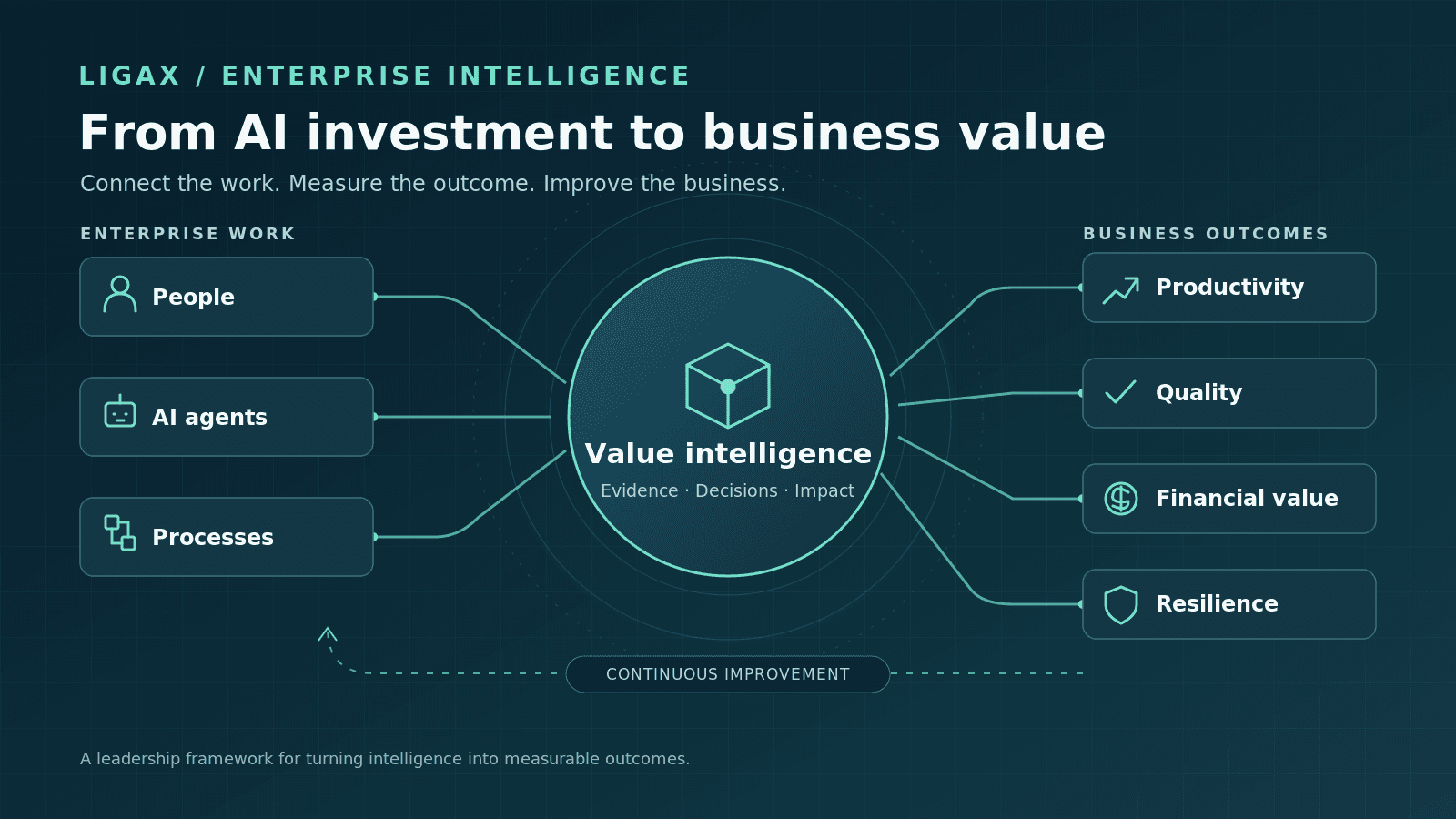
A leadership perspective on turning enterprise knowledge into reusable, governed AI capabilities that improve business outcomes, operational resilience and economics.


Key takeaways
- The next competitive advantage is not how many AI agents a company deploys, but how well it turns its knowledge into reliable, reusable and measurable business capabilities.
- A business skill is more than a prompt. It combines an objective, data, business rules, permitted actions, evidence and a definition of success, and it can be tested, versioned and improved.
- Measure AI by the balance of cost, quality, speed and risk per completed business outcome, with an owner and a baseline for every initiative.
On this page
For decades, enterprises have invested in systems that record transactions, automate processes and provide visibility into performance. Artificial intelligence introduces a new possibility: an enterprise that can use what it knows to decide, act and improve, within the boundaries set by its people.
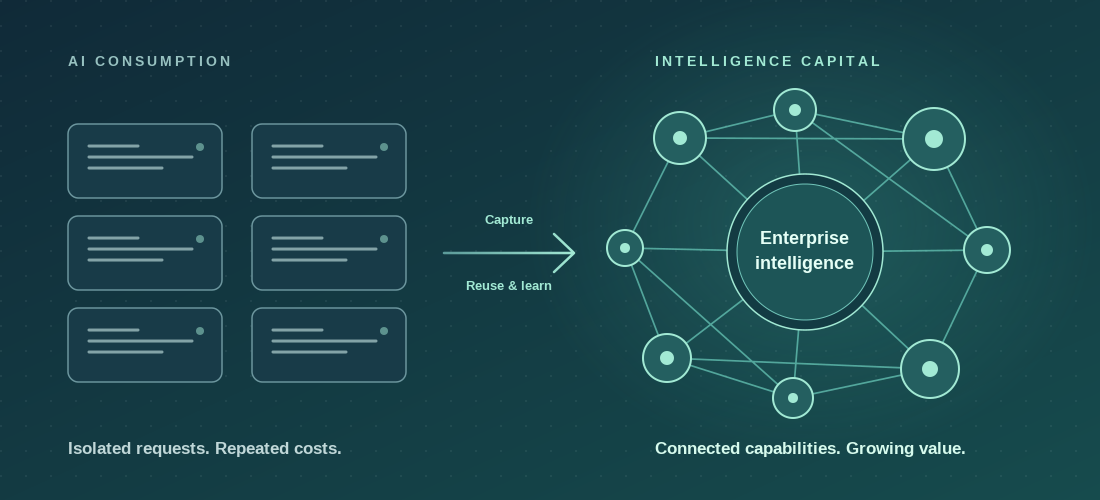
Yet many organizations are still approaching AI one chatbot, one assistant or one pilot at a time. These initiatives can be useful, but they often leave the underlying business fragmented. The real opportunity is to make intelligence a shared organizational asset, rather than a collection of disconnected experiments.
What operating AI at scale teaches us#
Uber Engineering offered a useful example in its November 23, 2026, article on agent skills. Its internal marketplace grew from one skill to more than 5,000 in roughly a year, and agents recorded more than one million skill invocations in a month.
- Reusable skills in Uber's internal marketplace, up from one in October 2025
- 5,000+
- Recorded skill invocations in one month
- 1M+
The significance is not simply the scale. Uber describes a disciplined approach to packaging workflows, distributing them across agent environments, evaluating their performance and refining them using feedback. It is an example of how AI can become infrastructure rather than remain a collection of individual applications.
An agent can perform a task. A reusable enterprise capability can improve how an entire organization performs that task.
From individual agents to shared enterprise intelligence#
Consider the expertise that already exists inside every business: how a finance team reconciles invoices, how a network engineer diagnoses an outage, or how a construction manager identifies a project at risk.
Much of that knowledge lives in documents, applications and the experience of individuals. By translating it into reusable capabilities — or skills — organizations can make that expertise available wherever it is needed, while preserving accountability.
A business skill is more than a prompt. It combines an objective, the relevant data, business rules, permitted actions, evidence requirements and a definition of a successful outcome. It can be tested, versioned and improved as conditions change.
What this means for business and operations leaders#
The value of enterprise AI should be measured in the work it improves, not just the questions it answers. The same intelligence foundation can support very different functions across a business.
Telecom & network operations
Restore services faster
Correlate alarms, identify affected services, check recent changes and recommend an evidence-based response.
Value: faster incident resolution and fewer unnecessary escalations.
Infrastructure & construction
Protect project delivery
Connect permits, material availability, contractor progress and financial forecasts to surface emerging blockers.
Value: fewer avoidable delays and more predictable capital spending.
Finance & procurement
Improve cash conversion
Identify completed but unbilled work, reconcile invoices and surface exceptions for authorized review.
Value: reduced revenue leakage and better working capital visibility.
Security & resilience
Reduce operational exposure
Connect findings to business-critical assets and coordinate remediation through approved workflows.
Value: more focused remediation and stronger operational accountability.
In each case, the goal is to move beyond dashboards that explain what happened. The next generation of business applications should help leaders understand what needs attention, what options are available and what action can be taken safely.
Better AI economics are a leadership responsibility#
Scaling AI responsibly requires controlling the cost of delivering a business outcome. Routine calculations, standard validations and predictable system actions often belong in conventional software. Bounded language tasks may be handled by smaller models. More demanding reasoning should use more capable models when the business need justifies it.
Choosing the appropriate execution method helps enterprises avoid paying for unnecessary intelligence. Reusing validated capabilities also reduces duplicated development, testing and maintenance across departments.
The objective is not the lowest cost per token. It is the right balance of cost, quality, speed and risk per completed business outcome.
How executives should measure progress#
Every AI initiative should have an operational owner, a measurable baseline and a business outcome. Leadership teams can start with five questions:
| Leadership lens | What to measure |
|---|---|
| CEO / growth | Revenue enabled, customer experience, speed to market |
| CFO | Cost per successful outcome, margin impact, cash conversion |
| COO | Cycle time, throughput, first-time-right rate, rework |
| CIO / CTO | Reliability, capability reuse, integration effort, model cost |
| Risk / security | Policy compliance, unauthorized action prevention, auditability |
High adoption alone is not proof of success. The enterprise must be able to demonstrate that its intelligence is making work better and that benefits exceed the full cost of operating it.
Trust must be built into the operating model#
AI should not acquire authority simply because it can act. Every capability must operate under appropriate identity, permissions, data boundaries and approval policies. High-impact decisions should remain with accountable people unless explicitly delegated within tested limits.
Continuous improvement must be governed too. Agents can identify failures and propose changes, but updates should be evaluated, reviewed and released through a controlled process with rollback. Enterprises should own their policies, operating knowledge and performance evidence, even as the underlying AI models evolve.
The LigaX vision: Intelligence as productive enterprise capital#
At LigaX, our vision is to help organizations build a shared intelligence infrastructure that connects existing systems, captures operational expertise and enables people and AI to work together.
We see the enterprise of the future as one in which teams can create capabilities once, reuse them across authorized workflows and continuously improve them using real business feedback. Over time, this creates an accumulating asset: the organization's ability to deliver better outcomes with greater consistency.
Leadership teams do not need to transform everything at once. Start with a high-value workflow, establish its baseline, capture the expertise, test the controls and measure the outcome. Then make the successful capability available to other teams.
The future belongs to enterprises that do not simply adopt intelligence, but systematically build, own and improve it.